
Together with friends and colleagues from my university, we are currently developing a SaaS Startup. Our product is placed in the B2C Learning & Development sector as it allows for new levels of co-creation, empowering learners and instructors to develop high-quality professionalization programs cooperatively. The focus of NEXTGEN.LX is on transformative organizational learning processes. We develop a culture-creation platform.
The first thing that I learned from other Startups was that the era of so-called minimal viable products (MVPs) The first thing I learned from other early-stage companies was that the era of so-called MVPs (Minimal Viable Products) seems to be over. There are several reasons for this. Firstly, the standard of products entering the SaaS market has risen enormously in recent years. People are not particularly interested in a product that is only 80% complete. As many customers have already found some sort of digital solution to their problems, it is hard enough to get them to try new products. It is a highly competitive world out there. The latest trend is to talk about maximum viable products (MxVPs), classifying those that create the most value for the customers.
Technologically, creating a digital social hub is challenging, especially if we intend to integrate it with productivity tools – otherwise it would be ‘just’ a social network. In this case, one of the main challenges is to seamlessly integrate the features of a social hub into the collaborative productivity software. This requires a well-designed user interface and an intuitive user experience to ensure that users can easily switch between social interactions and productive tasks. Improved data security, needless to say, is a must. Implementing a new platform usually requires additional training and gaining user acceptance. Employees or members need to understand how they can use the combined platform to work or communicate more effectively.
But socialware is so much more than a technological concept and development. As I sketched out the social prerequisites of our new technology, it became clear to me that the creative framework, the underlying formal syntax, and the user communities are all interdependent. Unlike other types of software, such as those for financial markets or business management, the evolutionary pipeline is driven much more by the experience of social interactions (that work in the foreground) and less by automated systems (that work in the background). User loyalty is also driven by experiences of self-efficacy and the question: what’s it it for me? Ideally, users will want to participate and even use a social hub to offer useful services or sell digital tokens. Think from bazaar to market-place.
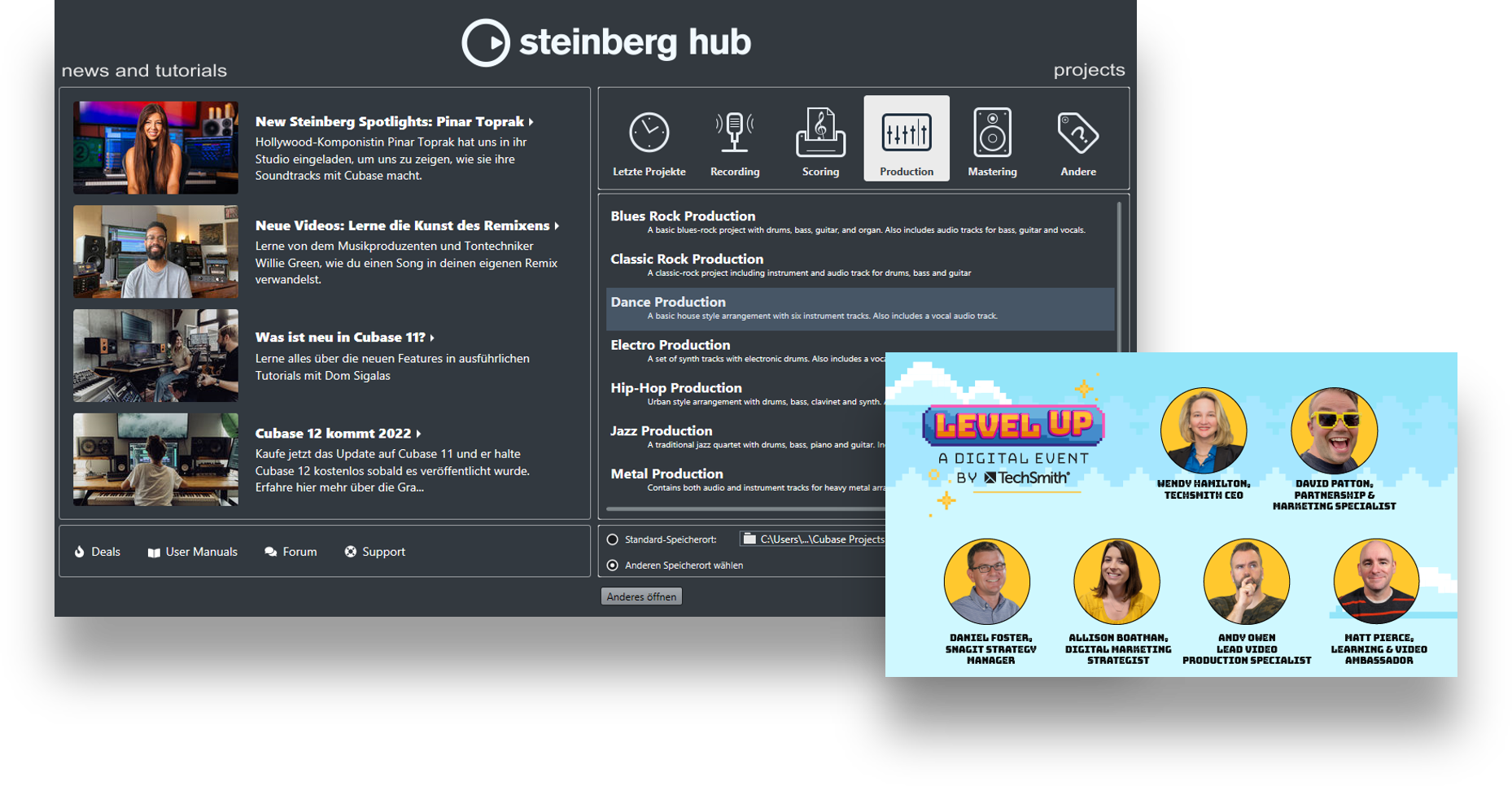
People want to connect. They expect to network with peers, experts, support or inspirational masters. People love to be invited to inspiring events or simply to access training materials to teach themselves. They do not expect a blank GUI yawning in their face. Or feel left alone staring at ‘latest projects’. Social Startups are in the people business, which means we are in the empathy business – connecting with people in a professional, empathetic and sincere way. So we stay away from mediocre chatbots that understand less than a goldfish and avoid bombarding new customers with annoying survey pop-ups. Besides, many users have developed allergic reactions to overwhelming automated feedback systems. People love to meet people in safe, professional spaces.
For example, when I fire up Steinberg’s music creation software, I’m greeted by a social hub by default, with essential how-to videos and expert insights. Or I get an invitation from ‘Camtasia’ to ‘TechSmith Academy’ masterclasses that not only give me tips on software features, but also other useful information such as script writing, how to improve workplace communication with visuals, or video marketing. Feel free to add your own examples. Connecting with customers is not just a nice optional feature in ‘forums’ – it is the foundation of the business.
Similarly, we need to plan any kind of socio-digital environment from the ground up. The question is not so much ‘What kind of software should we build?’, but ‘How can we bring communities and our StartUp together so that we can continue building relevant products?’ Human-centred design is a far cry from expecting software to sell itself just because it promises fancy USPs. Don’t get me wrong. USPs are extremely important, but we need to go one step further. If you are a people person, you are likely to have the most rewarding experiences. A good hub is like a hug, only in software.
Photography credit: Lauren Wood
 Joana Stella Kompa