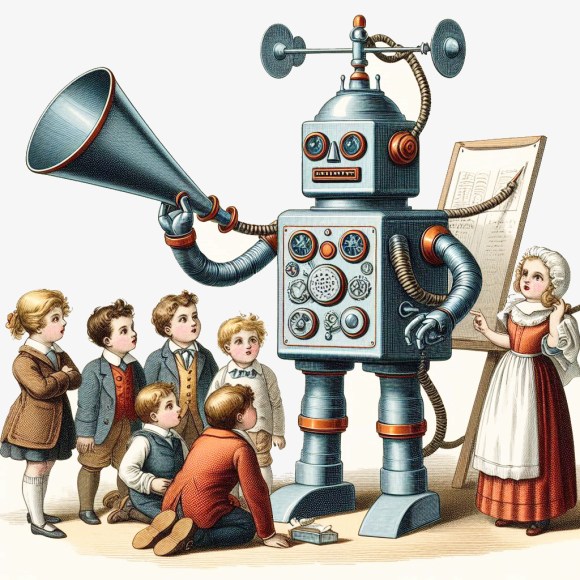
When it comes to simple knowledge acquisition, learning is simple: Just read the damn book! You read it and I give you a test on it tomorrow – so stay on your toes!
What is even more fabulous is that you have no say in such a learning process, neither in its purpose, its learning goal, whether it makes any sense to you whatsoever or not, nor whether filling out a multiple-choice test on critical thinking is an appropriate method for advancing your philosophical sophistication. Algorithmically speaking, we are dealing with a standardised input-output model, with you as the enigmatic black box in the middle.
The First Wave: The Instructional Era.
And no matter how good or bad your honourable efforts shake out, you will be measured on a standardised scale based on Gaussian distribution, also known as the bell curve. By the way, is not YOU that is being measured, but you against an expected normative average – so, well, never take things too personally. Average people may not recognise your genius. So keep your inner orange shining.
However, a standardised assessment is fantastic if you happen to end up on the other side, if you’re an instructor who doesn’t care about learners, or a lazy teacher who doesn’t take his job too seriously. Right answer, wrong answer, final mark – and the job is done! Let’s call the first wave of traditional learning the instructional era.
Below: Laurentius de Voltolina (1300s), University of Bologna. Watch the guys in the last row.

The Second Wave: Constructivists’ Awakening
In 1993, Alison King published the groundbreaking paper ‘From Sage on the Stage to Guide on the Side‘.
She proposed a plethora of new, dazzling terms such as active learning, guided reciprocal peer questioning or cooperative learning. She dared to open Pandora’s box. The days of simplicity were over. If you like, you can stop reading here, give up, raise a white flag and move on to some other fun activity, because it gets much more complex from here on.
King proposed the new paradigm of learner-centredness. In line with many other educational giants such as Maria Montessori, John Dewey, Albert Bandura, Ryan & Deci, Howard Barrows and many others, we enter the realm of social constructivism. In this world we ask for authentic problems as the basis for relevant learning, creative solution development, cooperative learning formats, self-directed learning, formative feedback and much more.
For the first time, learning had to be organised in a process form, such as design thinking, problem-based learning or scientific inquiry. Learning had to be structured along logical stages such as hypothesis generation, method selection, data collection, data analysis and critical peer review. Needless to say, the number of methods exploded exponentially, both in quality and quantity. Suddenly, it was not knowledge or knowledge management that was at the top of the agenda, but how to test knowledge epistemologically (‘how do we know we know?‘) or how to create new knowledge. In this way, process began to triumph over content-knowledge. Knowledge is only useful to us to the extent that we can integrate it into concepts and frameworks that allow us to connect ideas with facts. In this way, knowledge is transformed into knowledge assets (T.R. Clark), to put a positive spin on knowledge.
In the process of innovation, however, learning is more important than knowledge.
There have been detours along the constructivist path. In the early 2000s, we witnessed the dawn of digital education. The promise was: Learn what you want, when you want, how you want. It sounded swell, and we believed it for a very long time. The magic word was ‘personalised learning’. The problem was that it came at a price. This was the loss of social context and motivation, the loss of collaborative learning, and the loss of meaning in learning while online learning providers mushroomed into content-supermarkets – promising hardly recognized certificates to go with it: Are you legit? Have you collected your $40 certificate?
Today, some two decades later, more and more companies are cancelling their subscriptions to online content in order to invest their money in more promising interventions. One of the reasons that learning has become more complex is simply that our world has become more complex. My favourite quote is from the former Secretary of Education during the Clinton administration, Richard Riley: “We are currently preparing students for jobs that don’t exist, using technologies that have not yet been invented, to solve problems we don’t even know are problems.”
We shall call the second wave of modern learning the constructivists’ awakening. Oh, I forgot to mention: Learners are allowed to have fun, being self-directed, co-creative and all. ☺️ The take-home message is: It is not only important what we learn, but how we learn.
The Third Wave: The Rise of Social Learning Design
But let’s get to where we are now. Learning design has diversified further. We are not only concerned with learners’ intrinsic motivation and the contextual relevance of learning, we are equally talking about autobiographical trajectories, team dynamics, psychological safety, the learning experience, not only about working in a single team but new ways of multiple teams working together in complex projects, facilitating organisational change processes and much more. What happened?
Social and economic organisation has become more heterogeneous. It is no longer sufficient to think in terms of competency-based learning at the individual or group level, but we need to take into consideration complex interactions at the personal, team and system levels. Such a holistic approach exists at best in rudimentary fragments, such as systemic coaching approaches or methods developed in management consulting.
At NEXTGEN.LX, we have cracked the code: we are able to create coherent models of highly complex learning processes in algorithmic form by working with a vivid palette of learning actions, rather than content. By using a visual language, similar to the SCRATCH programming language for children, we are able to let users focus on the creative, social and interactional aspects of learning design, all the wonderful creative stuff, while the bulk of the fine-tuned parameters are hidden behind the programming blocks, or, in our case, easy-to-use colour-coded learning activities as disguised data objects.
Below: Visual Design @ nextgen.lx

We call this third wave of learning ‘Social Learning Design‘. It recognises that we are not just dealing with an active learning environment, but that we are designing learning across social realities that are all interconnected: the person, the team, the organisation, society and the world-at-large – for each relevant intersection.
In this way, we can measure social impact according to the alignment of social realities and their interdependent real-world influences. We’ve come a long way from’ You better read this damn book’.

 Joana Stella Kompa