
3. Social Learning Design: Architecture instead Moral Appeal
Core design principles
The concept of social learning design operationalizes psychological safety through five architectural principles that target organizational learning conditions as outlined in the following:
The technological decoupling of status and contribution
- Roles are abstracted from personal identity by discussing roles in the team (e.g. as problem solver, researcher, team lead), e.g. via 360-degree, multi-perspective evaluations
- Content is weighted according to learning value in an AI-augmented error culture, not according to sender authority
- Hierarchical positions become functionally invisible in learning contexts. Social friction is minimized, and the compatibility of intellectual friction is maximized to encourage the joyful development of new ideas and concepts.
Time limit on exposure
- Visibility windows are limited, which means that the system defines time-limited phases during which posts are visible, editable or retractable.
- The embedding of social presence is actively designed, not blindly assumed
- Clear transitions between responsibility (and accompanying critical thinking) for tasks, processes and results are structurally marked.
Functional weighting of uncertainty
- Questions, doubts and contradictions are algorithmically valorized
- Incompleteness is recognized as an epistemic contribution
- Early, well-founded and constructive contributions are explicitly rewarded
Predictability of social consequences
- Clear, consistent system responses to contributions
- Elimination of ambiguity regarding “what happens if I say X”
- Security is socially constructed as knowability, not comfort (Edmondson, 2018)
Vulnerability as a functional resource
When the system rewards early articulation of uncertainty, when questions carry equal weight to answers, when reasoned changes of position are tracked as part of the learning process and not romanticized as inconsistency, the role of human vulnerability shifts from moral virtue to operational necessity.
4. The Social Development Role of AI @ NextGen.LX: Open Learning Spaces instead of Streamlining
The AI component functions as what we internally refer to as a social operating system, which maintains the infrastructure and conditions for collective thinking and coordinated action rather than optimizing individual learning paths. In our concept, the AI evaluates contributions according to their epistemic value by continuously checking whether a contribution expands collective understanding, introduces necessary perspectives, or productively challenges existing consensus. This evaluation is independent of the hierarchical position or formal status of the contributing person, making shared learning value the primary criterion for visibility and weighting.
Furthermore, AI based on social learning design synthesizes polyphony without leveling. It creates collective meaning-making artefacts that integrate divergent perspectives without harmonizing them. Tension and contradiction are preserved rather than resolved, and emergent patterns are visualized without the system pushing prematurely for consensual conclusions. Creative tensions must be productively endured.
This enables teams to remain in modes of complexity and creative flow and to utilize productive ambiguity as a resource. Ultimately, AI orchestrates social conflicts productively by simultaneously maintaining and highlighting incompatible perspectives without individuals becoming the bearers of these tensions. Dissent is depersonalized in this respect, i.e. it appears as a structural feature of the problem, not as an interpersonal conflict. In this way, the system maintains productive tension without escalation and creates the conditions under which different perspectives can coexist without jeopardizing social cohesion.
Our approach differs fundamentally from adaptive learning systems (which personalize content), intelligent tutoring systems (which optimize individual mastery) or learning analytics (which measure and predict performance). Instead, AI acts on the social field, not on individual learners. Recent research on AI and collective intelligence (Rahwan et al., 2023; Woolley et al., 2023) shows that machine systems can actively shape social coordination when they are designed as infrastructural layers rather than autonomous agents.
4.1 From knowledge units to learning-activities: The storyboard approach
A key distinguishing feature of social learning design lies in the fundamental shift from static units of knowledge to dynamic learning processes. Learning does not come about simply by absorbing information. It is not only what people learn that is crucial, but also how they learn, i.e. through active, reflective and experience-based engagement.
This is a new paradigmatic assumption as compared to classic knowledge management: new knowledge arises when we engage with the world in a reflective and active manner, connect with others, test hypotheses, reject them and develop them further. It is only through learning by doing that our concepts and theories take shape. Only through reflective action can we make old beliefs compatible with new circumstances. And only through learning actions (hereinafter referred to as ‘learning activities’) do these find their way back into practice.
While learning management systems structure content as self-contained modules aimed at knowledge acquisition, NextGen.LX works with learning activities. These are composed into sequences of meaningful learning processes in so-called storyboards. This gives learning processes a proactive, social, adaptable and epistemically grounded structure. This is particularly crucial in the field of innovation and transformation, or as Timothy R. Clark summarized as a key concept:
“In the process of innovation, learning is more important than knowing.” (2020. p.123)
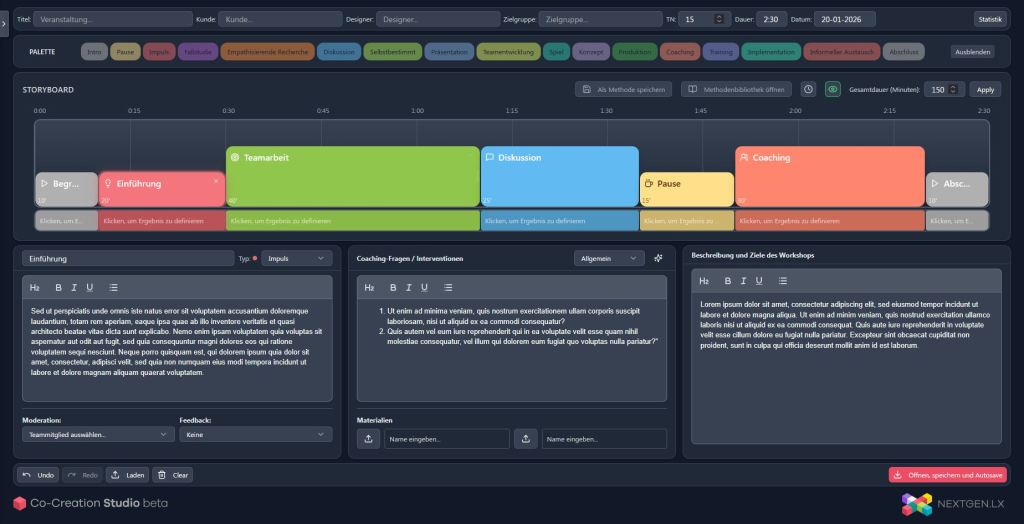
Screenshot 1: Storyboard example at NextGen.LX. Sequences of learning activities map complex processes, such as those of design thinking, systemic design, agile project management or problem-based learning (PBL). Protected design, DMPA, January 2026.
4.2 Theoretical foundation
This approach is based on three scientific strands:
Firstly: Nonaka’s SECI model (Socialization, Externalization, Combination, Internalization) of organizational knowledge generation (Nonaka, 1994; Nonaka & Takeuchi, 1995). Nonaka conceives of knowledge not as a static object, but as a process of continuous conversion between tacit and explicit knowledge. His “knowledge spiral” describes how individual knowledge develops into organizational knowledge through social interaction, articulation, combination and internalization.
Social learning design operationalizes this spiral: storyboards make conversion modes explicitly designable, AI orchestrates the flow between them (for example, as a coaching- and design assistant and method translator). The architecture ensures the psychological conditions under which these processes can take place in the first place.
Secondly: Senge’s concept of the learning organization (Senge, 1990), which defines organizational learning as a continuous process that promotes learning and knowledge generation at all levels, defines processes for the circulation of knowledge and translates this knowledge into measurable behavioral changes. The critical extension: While Senge describes the necessity of such processes, social learning design provides the operational infrastructure for their technological implementation.
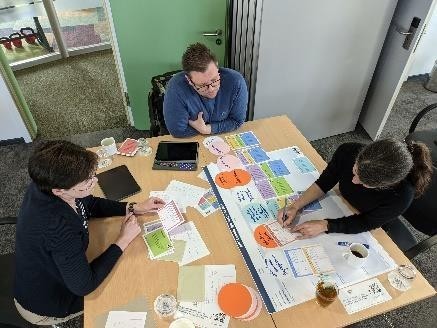
Thirdly: Diana Laurillard’s Conversational Framework (Laurillard, 2002, 2012) conceptualizes learning as an iterative dialogue between teachers and learners, in which concepts, tasks, feedback and reflection are organized in systematic cycles. This approach emphasizes the need for learners to articulate and apply their understanding, receive feedback and adapt; a process that requires social interaction and psychological safety. Social learning design extends this framework to the organizational level and renders dialoge-based structures technologically scalable. The picture below shows the first analogue implementation of learning activities in a storyboard at the University College of London (UCL).
 Joana Stella Kompa