7. The Conceptual Connecting-Points
While no existing system can yet combine AI, psychological safety and organizational learning conditions, there is supporting evidence across domains for its conceptual plausibility.
Psychological safety and performance (Edmondson, 1999, 2018; Frazier et al., 2017) establishes the performance criticality of psychological safety and shows robust correlations between psychological safety, learning behavior, and measurable performance improvements of 12–27% in innovation and problem-solving contexts.
Status and Voice (Morrison, 2014; Nembhard & Edmondson, 2006; Detert & Burris, 2023) documents how hierarchy suppresses learning and quantifies the resulting loss of innovation at 25–40%.
Organizational learning systems (Argyris & Schön, 1978; Senge, 1990; DiBella & Nevis, 1998) theorize learning as a system property and show that organizations with internalized learning competence exhibit 40–60% higher adaptation speed in volatile markets.
AI and social dynamics (Rahwan et al., 2023; Woolley et al., 2023) explore collective intelligence and machine mediation, with initial findings that AI-supported social coordination can increase group performance by 15–35% when designed as infrastructure rather than as an individual tutor.
Design for behavioral change (Thaler & Sunstein, 2008; Fogg, 2009) shows how architecture shapes behavioral choices, with proven effect sizes of d=0.6–1.2 for structural interventions compared to d=0.2–0.4 for normative appeals.
8. The Evidence Base
The future of work is characterized by accelerating change, radical uncertainty and unprecedented problems. Under such conditions, it is not the organization with the best training programs that wins, but the one that learns the fastest. Social learning design represents a paradigm shift: from optimizing learning delivery to creating social conditions in which collective intelligence emerges. By developing psychological safety as a predictable system property rather than a cultural aspiration, our approach addresses the structural barriers that have limited organizational learning for decades.
8.1 Value proposition for investors
Social learning design taps into market potential at the intersection of three converging trends:
8.1.1 Scalable social AI: The AI component in NextGen.LX is not tutorial-based, but infrastructural, which is a novel use case that defines the next generation of organizational software. While the global market for learning technology is estimated to be worth £375 billion by 2025
$375 billion by 2025 (HolonIQ, 2024), existing solutions primarily address content delivery. Social learning design taps into the previously unsolved $180 billion segment of “organizational capability development” through the technological operationalization of psychological safety.
8.1.2 Culture-by-design as a competitive advantage: Organizations that can design culture as a system property rather than a side effect of leadership behavior have been shown to achieve 3.5 times higher transformation success rates (Edmondson & Harvey, 2024) and 40– 60% faster market adaptation (DiBella & Nevis, 1998). The ability to scale this technologically creates effective international competitive advantages. Culture-by-Design aims to develop social cohesion through inclusive teams and thus reduce staff turnover.
8.1.3 Savings through internalization: Medium-sized companies spend an average of 15– 25% of their L&D budget on external consulting and episodic training interventions (Bersin, 2023). Social learning design enables the internalization of these capacities, which conservatively estimates savings of £150,000–£500,000 annually for organizations with 500 to 2,000 employees, while simultaneously increasing organizational learning competence.
8.1.4 Productivity gains: Empirical studies show that structurally anchored psychological safety increases innovation output by 12–27% (Frazier et al., 2017), improves decision quality by 15–20% (Woolley et al., 2023) and reduces the time to problem solving in complex tasks by 25–40% (Edmondson, 2018). For knowledge-intensive organizations with average personnel costs of €80,000 per FTE, this corresponds to measurable productivity increases of €12,000–€21,600 per employee per year.
8.2 Value proposition for strategic partners
See separate tables and reference in the appendix.
For consulting firms, technology providers and transformation partners, social learning design opens up three strategic expansion opportunities:
8.2.1 Extension of the value chain: Integrating social learning design into existing transformation, change or digital adoption offerings creates sustainable post-implementation value. Instead of episodic interventions, partners can sell continuous organizational learning capability as an outcome.
8.2.2 Differentiation through outcome orientation: While traditional consulting delivers processes and methods, social learning design enables the delivery of verifiable outcomes: measurable increases in innovation rate, decision-making quality and adaptation speed. This shifts the value proposition from “we conduct workshops” to “we build structural learning capabilities”.
8.2.3. Scaling without proportional resources: The technological platform enables transformation initiatives to be scaled without a proportional increase in consulting capacity. Partners can serve more customers with consistent quality, while process expertise is internalized in the customer system.
8.3 Summary for investors:Timing – Why now?
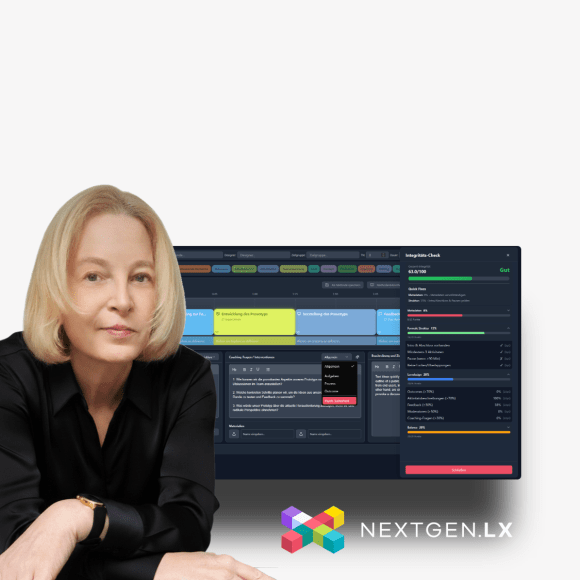
NextGen.LX is not an EdTech platform, an HRTech tool, collaboration software or a coaching hub, but rather an AI-supported social infrastructure for collective intelligence in organizations (Rahwan et al., 2023; Nonaka & Takeuchi, 1995; Woolley et al., 2023). NextGen.LX defines a new category beyond established segments such as EdTech, HR tech or collaboration software.
Traditional learning and HR solutions optimize either content delivery, individual (soft) skills or talent processes. Collaboration tools primarily address communication and coordination (Bersin, 2023; HolonIQ, 2024).
NextGen.LX operates on a different level: as an AI–augmented social infrastructure for collective intelligence, the platform shapes the social conditions under which collective thinking, contradiction and rapid hypothesis cycles arise in the workflow (Argyris & Schön, 1978; Senge, 1990; DiBella & Nevis, 1998).
In our concept, AI acts not only as a tutor or recommendation engine, but as a social operating and facilitation system that decouples status from contribution, algorithmically rewards uncertainty, and implements psychological safety as system behavior (Edmondson, 2018; Clark, 2020; Rahwan et al., 2023). This creates a new addressable category: scalable social infrastructure that directly influences an organization’s transformational capacity and learning speed for a future market that is structurally driven by the growth of mature, specialized AI infrastructures and the need for resilient hybrid organizations (Databricks, 2025; Johnson Centre, 2025; Teece, 2022).
The timing of the emergence of social learning design is no coincidence. Firstly, specialized AI models have reached a level of maturity in the last two years that enables their use as horizontal infrastructure in companies, and investment in AI-based platforms is growing exponentially (Databricks, 2025; HolonIQ, 2024).
Secondly, the pressure of complexity is increasing in markets where organizations are increasingly confronted with problems without a clear solution path. Under these conditions, learning speed determines competitive advantage (Snowden & Boone, 2007; Teece, 2022).
Thirdly, hybrid and remote working increase coordination costs and the risk of silent misinterpretations. Research points to new “coordination taxes”, which, as already outlined in the concept of social load, are hidden, systemic costs that arise in organizations because work must be coordinated, synchronized, legitimized and socially secured before it can be effective. Added to this is increased social stress due to fragmented collaboration (Johnson Centre, 2025; Mark, Gudith, & Klocke, 2008; Perlow, Allen, & co-authors, 2017).
Prior to this constellation, psychological safety was known conceptually, but was hardly scalable in practice. It depended on individual leaders, workshop series or local team cultures and could not be reproduced as a reliable system property (Edmondson, 1999, 2018; Schein & Schein, 2017). Only the combination of mature AI infrastructure with an architectural design approach makes it possible to provide psychological safety, individual voice and collective intelligence as a platform function. This is precisely where NextGen.LX positions itself (Rahwan et al., 2023; Woolley et al., 2023; DiBella & Nevis, 1998). Also see Appendix. ‘Comparison NextGen.LX to conventional knowledge management and LMS.
8.4 Organizational Impact in Numbers
For organizations, NextGen.LX delivers what decades of change management have promised but failed to deliver in terms of methodological implementation: the ability to learn at the pace of change. The combined effects of the new infrastructure are outlined below.
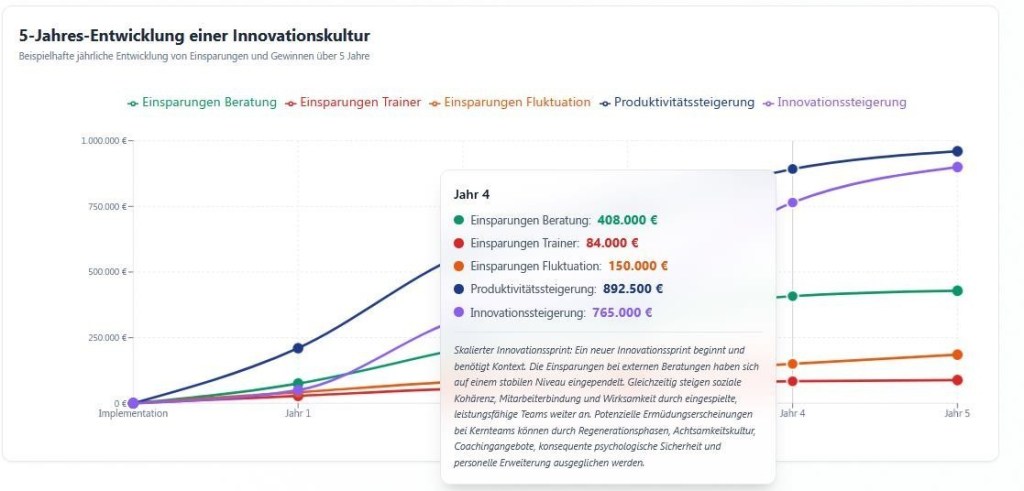
Screenshot 2: Excerpt from the NextGen.LX return on investment calculator. The data scenarios show that NextGen.LX is positioning itself as a systemic platform for cultural development for learning organizations. Generally, customization slows scalability, unless we can largely automate it.
Measurable Savings:
Reduction of external consulting costs by 15-25% of the L&D budget (Bersin, 2023; LinkedIn Learning, 2024), reduction of time-to-competency in new domains by 30-50% (Noe et al., 2022; Tannenbaum et al., 2023), and reduction of social load through structural clarity with less unproductive social coordination efforts (Edmondson, 2018; Allen et al., 2023; Perlow et al., 2017). Measurement data for this new factor has yet to be determined.
Measurable Gains:
The evidence base shows consistent performance improvements: a 12-27% increase in innovation output (Frazier et al., 2017; Baer & Frese, 2023), a 15-20% improvement in decision quality (Woolley et al., 2023; Larrick & Soll, 2023), acceleration of problem-solving speed by 25-40% (Edmondson, 2018), a 3.5- fold higher transformation success rate (Edmondson & Harvey, 2024; McKinsey & Company, 2023), and a 40-60% increase in market adaptation speed (Teece, 2022; Eisenhardt et al., 2023).
The question is no longer whether organizations need to learn collectively. It is whether we can develop and implement systems that structurally enable learning conditions. At NextGen.LX, we have developed such a forward-looking solution.
 Joana Stella Kompa